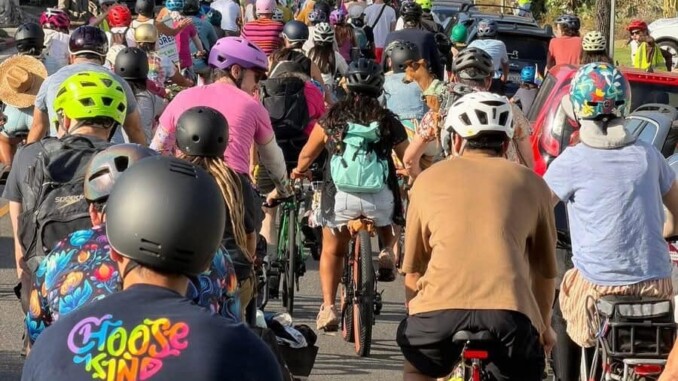
Culver City’s Walk’n Rollers and Bike Culver City held their sixth annual Pride Ride, combining advocacy for safer streets with a celebration of LGBTQ+ pride. On June 27, 2026, the 6.5-mile ride began at Ivy Station and ended at the Culver Steps, drawing hundreds of participants.
The event highlights ongoing efforts to improve local bike infrastructure while fostering equity and community inclusion.
Jim Shanman, founder of Walk’n Rollers and co-founder of Bike Culver City, said the event marked a shift in organization this year.
“We’ve been working with the Pride Festival for a year—usually we lead the ride,” Shanman said. “But this is our first year actually organizing the entire ride event. There’s a definite separation between the ride and the festival this year. They simply wanted to focus on the festival and have somebody else focus on the ride.”
Meghan Sahli-Wells, co-founder of Bike Culver City and former mayor, reflected on the origins of Pride recognition in the city. “In 2018, it was a high school student who asked me and my colleagues if we would raise the Pride flag in Culver City, and of course we said yes,” Sahli-Wells said. “That movement came from the youth of Culver City, who saw that we were not doing well and that we needed to do better. Thankfully, we are doing better.”
The sitting Vice Mayor Bubba Fish, who co-created the Culver City Pride Ride & Rally, the city’s first Pride celebration, emphasized the event’s neighborhood impact in remarks to Culver City Crossroads. “This Pride celebration is unique because it’s a parade that goes to where people live,” Fish said. “It’s a Pride parade that goes into neighborhoods, and kids come out of their houses and see that Culver City is a place where they are accepted and loved.”
School Board President Stephanie Loredo framed the event as an act of community care. “This event is collective care,” Loredo said. “Collective care is necessary for thriving, flourishing communities. In other places and spaces across the country including Southern California, our human rights and dignity are being stripped away—forced outing of students and withholding necessary, life-saving medical care. But here in Culver City, we have this beautiful power to come together and create this brave connective space.”
Adding more bike lanes remains an ongoing conversation among Culver City’s Bicycle and Pedestrian Committee, which works to establish a long-term vision for safer walking and bicycling throughout the city.
David Metzler, co-president of Bike Culver City, pointed to the ride’s growth and broader significance. “We have a better Culver City because the LGBT community has been brought together with pride,” Metzler said. “Even though the algorithms of billionaires have spent the last six years making us all feel smaller and less important, every year the ride has gotten bigger.”
Culver City’s efforts to expand bike infrastructure date back more than a decade. The city began installing shared-lane markings, or “sharrows,” on Wesley Street as early as 2011, according to its Bicycle and Pedestrian Action Plan. Its first traditional bike lanes were implemented in December 2012 on Sawtelle Boulevard.
In spring 2026, the city upgraded its two-way protected bikeway along Elenda Street and extended bike lanes along Washington Boulevard and La Cienega Boulevard to Washington and Fairfax as part of the MOVE Culver City Corridor.
One of the upcoming projects, the Better Overland Avenue Project, will create more than 2.5 miles of protected bike lanes. Approved by the City Council in June 2020, construction is expected to begin in 2026, though the project has faced pushback from some residents.
At the June 22 City Council meeting, the council reaffirmed the city’s commitment to Better Overland, which will create a north-south corridor connecting Culver City’s infrastructure to the Los Angeles bike lanes, expanding the network.
Clara Carvalho
