
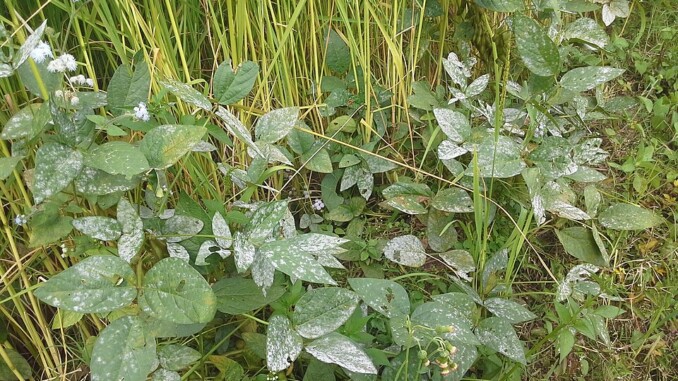
What is the white cover on my leaves?
Have you noticed recently that throughout the day we are experiencing marine layers? The weather is cloudy and foggy and you are thinking, do I need to wear a sweater? You may wonder, since weather like this affects my mood, does anything happen to the plants?
The morning dew and the cloudy weather has an effect on plants. It simply gives plants moisture. This is essential in our warm weather. Most plants benefit from it. However, are there plants that end up dying because of it?
Recently I got a text from my clients Rob and Lauren, who noticed a white cover on their iceberg roses. We planted them this spring in their cottage garden; the plants are overall healthy, but they do have plenty of white residue. So what is it? It is called powdery mildew, which is a fungal disease that looks like flour has been dusted on the tops of leaves and stems. The mildew will not kill the plant, but it is not helpful either. The leaves often curl and fall off early. It spreads by pores in the wind and it thrives in temperatures between 60-80 degrees with a little bit of dampness, so those pores are very happy in our Culver City gardens. You will notice them when we have a cloudy overcast that most of us call “June gloom.”
What plants are usual victims of the powdery mildew? I often see them on new leaves and undeveloped flowers of roses. The family of cucurbits which include squash, zucchini, pumpkins, melons, and cucumbers get mildew on their leaves. As well as the family of nightshades like tomatoes, eggplant, and sometimes peppers. Legumes like peas and beans also get mildew. Grapes also get covered in mildew, even on the fruit itself. We do not grow a lot of them in Culver City, but zinnias, phlox, dahlias, snapdragons, and chrysanthemums will get mildew on their leaves as well. Herbs that get affected by mildew include mint and basil. But from all of those that I mentioned, the most mildew that I see is on roses, zucchini, tomatoes, and cucumbers.
So the question is, how can you treat it? There are a few sprays you can use to spray on the plants, such as neem oil and copper fungicide. Both of those can be purchased in any local nursery. I like to purchase those with high concentration and use a spray bottle to dilute them.
There is also a mix of homemade sprays that can be used. Mix 1 tablespoon of baking soda and ½ teaspoon of liquid hand with a gallon of water. You could also simply remove and dispose of heavy infected leaves to reduce the spore count. I have tried all of those and for me it works best to spray the plant with copper or simply remove the leaves.
Sometimes it is easier to actually prevent the disease instead of dealing with the results of it. For one, you can choose disease resistant plants whenever possible. You can also prune plants to improve the air circulation and allow the sun to reach the inner foliage. In general the more airflow the plants have the harder for any insects or diseases to make room on your plant. Powdery mildew loves wet leaves, so watering on base of the plants and avoiding wetting the plant itself also helps. Too much nitrogen promotes rapid but weak new growth to avoid over fertilizing.
Powdery mildew is sometimes hard to avoid especially on zucchini and tomatoes, but creating some airflow and being preventive is very helpful. Any plant with powdery mildew I put in a green bin and do not put in a compost. Larger commercial compost heats enough to kill things, but at home it is harder to achieve those temperatures. Mildew is one of the reasons I do not overwinter tomatoes. Second year tomatoes almost always have powdery mildew. In reality it is very hard to avoid powdery mildew in our gardens. So we can just do our best to avoid and manage it.
Things also do much better in a garden if our soil is healthy. Paying attention to the basics like having enough organic matter with proper nutrients is often enough to avoid a lot of issues. So take care of your soil.
Just because we get diseases in our gardens, does not mean that you should stop planting. Nature is tricky and sometimes it surprises us in a positive way. But sometimes things can get disappointing. However, in a garden there is always another season or a spray that will be just what you need.
Happy Gardening!
Joanna Kotwis
