
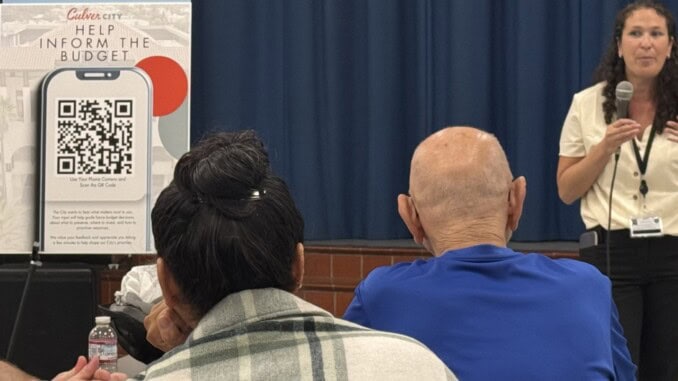
On October 21, 2026 Culver City hosted the second of four community workshops in its “What’s Next, Culver City?” series at El Rincon Elementary School. The initiative aims to demystify the municipal budget process and introduce elements of participatory budgeting. This practice is a democratic exercise where community members directly help decide local spending priorities.
While participatory budgeting has been used internationally for decades it remains a relatively new approach to finance in U.S. municipalities.
Chief Financial Officer Erin Spragan (pictured above) emphasized that public feedback gathered during the series will be evaluated alongside representative survey data and administrative analysis before reaching the City Council during its budget review on May 11.
During breakout sessions and a voting exercise, attendees identified three priorities: avoiding overdevelopment, supporting arts and the creative economy, and improving infrastructure.
Infrastructure concerns mirror the city’s current focus. “We are tripling our rate of sidewalk repair,” Vice Mayor Bubba Fish told attendees. “We’re doubling our rate of asphalt and street repair.”
However, resident calls to limit local growth run directly into statutory obligations.
Culver City is legally obligated by the California Department of Housing and Community Development to accommodate 3,341 new housing units between 2021 and 2029. Consequently, city leadership is tasked with walking a fine line, honoring some resident’s concerns about increasing housing while remaining compliant with state law.
The voting exercise also brought up questions around civic equity. One resident raised a concern using the example of how a larger, more organized homeowner block could easily out vote a smaller neighborhood for tree canopy funding through sheer numbers alone. That would leave smaller communities without adequate resources.
Acknowledging this challenge, Vice Mayor Fish reassured attendees that raw workshop votes serve as one data point among many.
“I hear your concern about ‘squeaky wheel’ budgeting,” Fish said, explaining that staff works to balance resources equitably across all neighborhoods. “It’s kind of like an art, not a science.”
The “What’s Next, Culver City?” conversation series will continue with two additional sessions in November.
Clara Carvalho
