
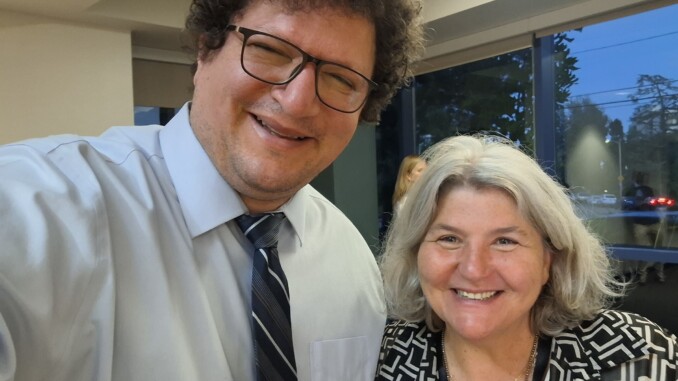
“We were the first ‘left’ slate, and we won.” Karim Sahli has the distinction of being a U.S. Citizen, a French citizen, and Elected Representative for the French People Living Abroad (aka Conseiller des Françaises et Français de l’étranger).
“It was a total upset. Most French [in the U.S.] vote to the right, but not this time.”
Politically, it’s a unique system. “There are about 3 million French people living abroad, of whom approximately 2.5 million are registered on consular electoral rolls — that’s roughly the same number of people who are residents of Paris. But not living in France does not mean we cannot vote in French elections.”
Multiple citizenship is recognized. A law passed in France on January 9, 1973, ended the automatic loss of French nationality upon voluntarily acquiring foreign citizenship, effectively allowing dual nationality. if you are a French citizen, accepting citizenship in another country does not affect your status.
When you move abroad, you inform your local French consulate that you have moved and they take you off their local voting rolls. “Then you can vote from wherever you are; we have voters in China, in India, and of course, U.S.” Sahli explained.
The system that offers representation to those living anywhere on the planet scored a huge win for the first ‘left-leaning’ slate to run. La Gauche Solidaire Et Écologiste was supported by EELV Senators Melanie Vogel and Mathilde Ollivier, along with Socialist Party Senator Yan Chantrel.
“Our district is scattered over five states, and we estimate about 100,000 French people [who live there] are eligible to vote, but only a quarter of that, 25,000 are actually registered on the consular electoral rolls. This whole group has 11 Assembly members and 12 Senators. The 7th constituency covers Southern California, Southern Nevada, Arizona, Colorado and New Mexico. While most French voters live in Los Angeles, there are also large concentrations in both Phoenix and Denver.
Sahli, as the elected representative for French people living abroad, has political responsibilities he compares to a city council member. “It’s not like there’s a Mayor, as such, but it’s a designation like council.”
Deglise stated “I am deeply honored to have been elected, and I look forward to serving the French community and working closely with the Consulate team. I am also committed to supporting our Senators in their efforts to advocate for the interests of French citizens abroad.”
Deglise, who also has the French title of Knight of the Order of Arts and Letters, is a graduate of the Sorbonne, and stepped down as the deputy director of American Cinematheque in 2022 to return to France and care for her aging parents. She has since returned, and is currently teaching at CalArts, and leading the Agnes Varda Educational Partnership.
While these officials have the power to help French nationals with things like passport problems, Sahli offered “The French Consulate here [in Los Angeles] is doing a great job, so there’s not a big demand for that kind of support from my office. The most important, for me, right now, is that I am a ‘grand elector, and the next French Senatorial election will be in September.” He considered it a similar designation be being a delegate to the Electoral College.
Deglise enthused, “Together, we can strengthen our community and ensure that every voice is heard.”
Judith Martin-Straw
Editor’s note – This article was updated on June 4, 2026 to correct previous numbers and add biographical information.
