
California aims to conserve an additional six million acres of open and green space by 2030 through its “30 x 30” goal. Culver City is contributing to that effort through investments in parks, recreation, and urban conservation.
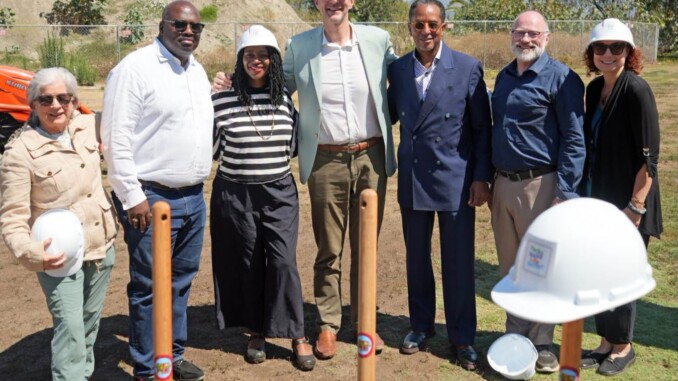
On July 6, the Parks, Recreation & Community Services Commission (PRCS) hosted a community event celebrating the groundbreaking of the Bill Botts Fields Reconstruction Project. Fields 1 through 3 at Culver City Park will be redeveloped into athletic fields for youth leagues by the end of 2026.
At the same time, the city is expanding efforts to grow and preserve its urban forest. Through its Urban Forest Master Plan, Culver City is developing strategies to increase planting space and promote equitable access to nature by 2030, aligning with statewide biodiversity goals outlined in Executive Order N-82-20.
California State Assemblymember Isaac G. Bryan, the first Culver City representative to chair the Natural Resources Committee, emphasized the importance of protecting green spaces in urban communities.
“Our bill, AB 946, calls for equal prioritization of protecting open and green spaces in urban areas wherever possible. And that includes fields like this,” Assembly member Bryan said. “The state should be thinking about conservation beyond just our forests and coastline, the spaces we have in urban communities matter too.”
A 2024 public survey found that 38% of Culver City park users visit parks several times a week, with 85% identifying as residents, underscoring the community’s reliance on local parks and the city’s efforts toward its 2030 conservation goals.
“I’m proud to be here at the groundbreaking. I’m always excited to be in Culver City because I think Culver City is an exemplary example of what a community should look like,” California Senator Lola Smallwood-Cuevas told Culver City Crossroads. “Every community should look like Culver City because Culver City understands diversity, equity and inclusion.
They understand that parks are essential to the quality of life.”
Over the last decade, Baldwin Hills Conservancy received significantly less funding than its neighboring Santa Monica Mountains Conservancy. This decade, Senator Smallwood-Cuevas and Assemblymember Bryan advocated for $70 million for the Baldwin Hills Conservancy to help advance California’s conservation goals in the Culver City region.
Youth sports organizations were among the strongest advocates for the project. Culver City Little League, which serves 500 boys and girls ages 4–16 each season, and AYSO Culver City, which serves hundreds of children ages 3–18, provided feedback that helped shape the project through the Culver City Parks Plan. PRCS staff also gathered input from more than 200 youth campers.
“This investment is long overdue,” Mayor Freddie Puza said. “There will always be voices that say not now, or not this way. They often agree with the destination; they just never seem to agree with the journey. But leadership is not about waiting for the perfect moment. Leadership is recognizing the right moment, and that moment is today, and our community has waited long enough.”
PRCS Chair Crystal Alexander noted that community members, especially Little League and AYSO coaches, have pushed for field improvements for years, with concerns predating her three-year tenure. At the beginning of 2025, the commission urged the City Council to adopt the Parks Master Plan, which addresses all 13 Culver City parks.
“We’ve been working with various members of the community who have been talking to the City Council, saying it’s time we pay attention to this kind of public infrastructure, because of what I reference as third spaces,” Alexander told Culver City Crossroads. “This is a public third space.”
Some park spaces remain underused. For example, an area on Leash Lane is currently occupied by Public Works Department equipment, and the high cost of relocating those operations has delayed efforts to transform the space into a community asset.
Still, the city’s new balanced budget signals a shift in priorities. Funding for Parks, Recreation, and Community Services increased from $12 million in fiscal year 2025 to $14 million in 2026—a roughly 17% increase and one of the largest recent boosts for the department. Funding is projected to decrease slightly to $13 million in 2027 but maintains the momentum of the 2026 investment.
City Manager Odis Jones said the challenge is balancing investments with other financial pressures.
“The fight that we engage right now is making sure we protect some resources for us with regards to the transfer tax. It has a big impact on us and our ability to rebalance our budget, but we want to maintain that balance,” City Manager Jones said.
Councilmembers Albert Vera and Dan O’Brien also attended the groundbreaking event.
Clara Carvalho
Photo (from L to R) PRCS Chair Crystal Alexander, City Manager Odis Jones, State Senator Lola Smallwood-Cuevas, Mayor Freddy Puza, Assistant City Manager Adam Troy, CFO Steve Angostini, and Senior Assistant City Manager Lea Ericksen.
