Looking Up by Bob Eklund
Looking Up -Bob Eklund
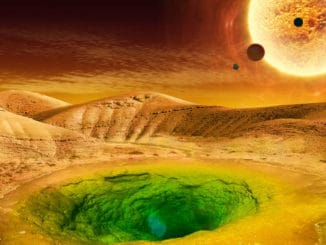
CLOSEST SINGLE STAR LIKE OUR SUN MAY HAVE HABITABLE PLANET – An international team of astronomers led by the University of Hertfordshire has discovered that Tau Ceti, one of the closest and most Sun-like stars, may host five planets—with one in the star’s habitable zone. At a distance of twelve light-years and visible with the naked eye in the evening sky, Tau Ceti is the closest single [...]
Looking Up – Bob Eklund
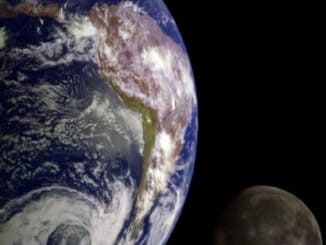
GRAIL LUNAR IMPACT SITE NAMED FOR ASTRONAUT SALLY RIDE – NASA has named the site where the twin Ebb and Flow spacecraft impacted the Moon on Dec. 17 in honor of the late astronaut, Sally K. Ride, who was America’s first woman in space and a member of the GRAIL mission team. On Dec. 14, Ebb and Flow, the two spacecraft comprising NASA’s Gravity Recovery and Interior Laboratory (GRAIL) [...]
Looking Up – Bob Eklund
CASSINI SPOTS MINI NILE RIVER ON SATURN MOON – The international Cassini mission has spotted what appears to be a miniature extraterrestrial version of the Nile River: a river valley on Saturn’s moon Titan that stretches more than 250 miles from its “headwaters” to a large hydrocarbon sea. It is the first time images have revealed a river system this vast and in such high resolution [...]
Looking Up – Bob Eklund
Composite map of the world assembled from data acquired by the Suomi NPP satellite in April and October 2012.Credit: NASA Earth Observatory/NOAA NGDC Scientists have unveiled an unprecedented new look at our planet at night. A global composite image, constructed using cloud-free night images from a new NASA and National Oceanic and Atmospheric Administration (NOAA) satellite, shows the glow of [...]
Looking Up – Bob Eklund
BIGGEST BLACK HOLE BLAST DISCOVERED – Astronomers using the European Southern Observatory’s Very Large Telescope (VLT) in Chile have discovered a quasar with the most energetic outflow ever seen—at least five times more powerful than any observed to date. Quasars are extremely bright galactic centers powered by supermassive black holes. Many of them blast huge amounts of material out into [...]
Looking Up – Bob Eklund
LOST IN SPACE: A PLANET WITHOUT A PARENT STAR – Astronomers have identified a body that is very probably a planet wandering through space without a parent star. This is the most exciting free-floating planet candidate so far and the closest such object to the Solar System at a distance of about 100 light-years. Its comparative proximity to us, and the absence of a bright star very close to it, [...]
Looking Up – Bob Eklund
GIANT TELESCOPE MIRROR COMPLETED – Scientists at the University of Arizona and in California have completed the most challenging large astronomical mirror ever made. For the past several years, a group of optical scientists and engineers working at the UA Steward Observatory Mirror Laboratory underneath the university’s football stadium have been polishing a 27.5-foot-diameter mirror with [...]
Looking Up – Bob Eklund
PAINTBALLS MAY DEFLECT AN INCOMING ASTEROID – In the event that a giant asteroid is headed toward Earth, it might help if it were blindingly white. A white asteroid would reflect sunlight—and over time, this bouncing of photons off its surface could create enough of a force to push the asteroid off its course. How might one encourage such a deflection? One answer, according to an MIT [...]
Looking Up – Bob Eklund
HOW TO HUNT A SPACE ROCK – Peter Willis and his team of researchers at JPL had a problem. Actually, more like they had a solution that needed a problem. Confused? Let’s let Peter give it a shot… “My team and I came up with a new lab on a chip,” said Willis, a scientist at JPL’s Microdevices Lab. “It essentially miniaturizes an automated sample processing and analysis instrument [...]
Looking Up – Bob Eklund
PLANET FOUND IN NEAREST STAR SYSTEM TO EARTH – European astronomers have discovered a planet with about the mass of the Earth orbiting a star in the Alpha Centauri system—the nearest to Earth. It is also the lightest exoplanet ever discovered around a star like the Sun. The planet was detected using the HARPS instrument on the 3.6-meter telescope at ESO's La Silla Observatory in Chile. The [...]