
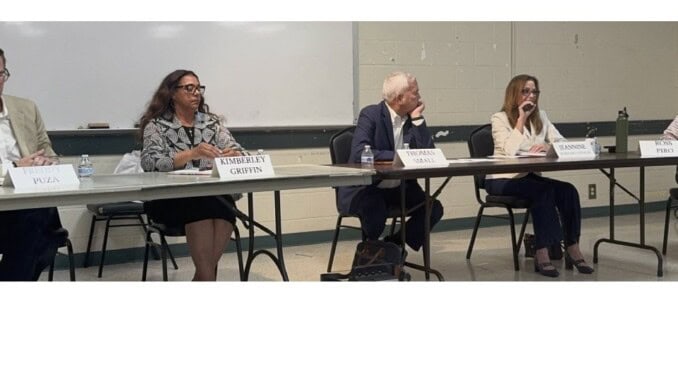
On August 17, 2026 approximately 50 local residents gathered in the Multi-Purpose Room at Veterans Auditorium for a City Council candidate forum hosted by Culver City Democrats United (CCDU). As several candidates had chosen not to appear at the taping of the online forum for the Culver City Democratic Club, it was the first time for local voters to have all of them on the same platform.
The four major contenders running for leadership: incumbent Mayor Freddy Puza, Former Mayor Thomas Small, and CCDU members Jeannine Wisnosky Stehlin and Kimberley Griffin. Moderated by the CCDU’s Ross Piro, the format included opening and closing statements, and gave every candidate two opportunities for rebuttal. Throughout the evening, clear differences emerged in policy priorities and in debate tactics.
Puza leveraged his experience on the dais, pointing to recent metrics to argue that Culver City’s current direction is yielding tangible results. He noted a 30% reduction in unhoused residents, a drop down to 74 individuals from 105 in the previous year, and cited recent polling indicating a 14% increase in residents who feel the city is heading in the right direction.
Puza framed public optimism around key municipal investments, focusing his campaign on expanding housing affordability and advancing safe transportation options, including the Better Overland project.
Wisnosky Stehlin and Griffin used their rebuttal time to attack the council’s financial record. Neither Puza nor Small used their available rebuttals, allowing the challengers to critique recent city spending.
In his responses, Puza stood firmly behind major housing and transit initiatives, while Small, an architectural consultant, maintained a neutral stance on both the affordable housing funding structure and the Better Overland project.
The forum’s most contentious moment centered on the financing structure for Jubilo Village, a planned 93 unit affordable housing project on Sepulveda Boulevard developed in partnership with the Culver-Palms Methodist Church and the Community Corporation of Santa Monica. The city secured $16 million in direct municipal loans from reserves and federal Section 8 vouchers, a contribution necessary to trigger matching state tax credits.
Puza defended the funding structure, noting the state’s rescinding of the Redevelopment money that was earmarked for housing had left cities to find another financial venue. “Historically, we never had invested in affordable housing in this way,” while acknowledging that drawing from reserves was a complex decision meant to tackle an urgent housing shortage.
Wisnosky Stehlin, a nonprofit consultant, countered the city’s narrative of a balanced budget, arguing that officials were “borrowing towards our reserves” and putting municipal parking structures up as collateral. Pointing to an industry average of closer to $3 million for municipal affordable housing contributions, she challenged the council’s financial strategy.
Griffin, who spent two decades in city law enforcement, echoed concerns over financial exposure and called for greater public oversight: “This decision should have gone to a ballot. If the residents said yes, ‘fund that’, then absolutely, we would move forward… I don’t think it was a risk that we should take.”
Small took on the housing question by asking members of the audience to raise their hands if they had a mortgage, and noted that many in the room were using that financial plan to access property. He went on to take a moderate position, describing municipal bonding as a standard governance tool, while also noting, “I might not have voted for that.”
With November 3 approaching, voters still have time to consider which candidates they will be voting for.
For information on voter registration or municipal voting logistics, visit the Culver City Election Information Portal or check the Los Angeles County Registrar-Recorder/County Clerk Office.
Clara Carvalho
Photo (L to R) Mayor Freed Puza, Kimberley Griffin, Thomas Aujero Small, Jeannine Wisnosky Stehlin, Ross Piro
Photo Credit Clara Carvlho
