
On July 23, 2026, planners and community members met at Culver City Hall for a final open house on the Hayden Tract Specific Plan, wrapping up public feedback before an October Planning Commission review and scheduled November City Council vote. The plan marks a turning point to transform the famous 20th-century industrial park into a high-density, transit-oriented neighborhood.
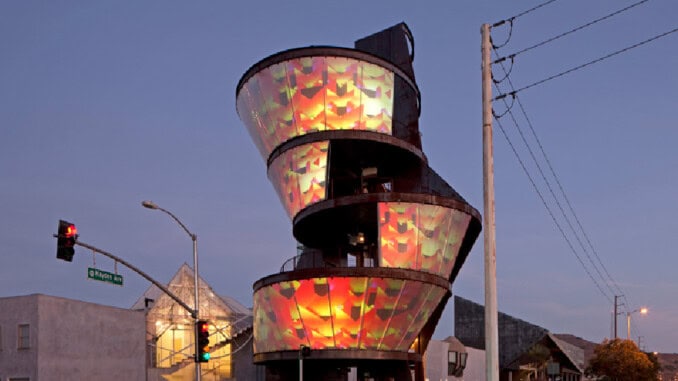
For 30 years, low rise warehouse conversions pioneered by Fred and Laurie Samitaur Smith and architect Eric Owen Moss defined the enclave, attracting corporate tenants like Apple.
Today, post-pandemic economic shifts are forcing the low slung, sprawling structures to adapt.
When Culver City adopted the updated General Plan 2045 in September 2024, it designated the Hayden Tract for mixed-use redevelopment. Single-use low-rise office space no longer pencils out for developers amid high regional vacancy rates. Culver City’s office vacancy sits at 25.7%, with 17 listings in the Hayden Tract alone, while nearby Santa Monica sits at 20.4%.
To restore financial viability, the Specific Plan raises the Hayden Tract’s current 56-foot height limit up to 110 feet (120 feet for hotels), while expanding density caps to grant developers the higher Floor Area Ratio (FAR) required to secure funding from banks.
State law is accelerating this local shift. Effective July 1, 2026, Senate Bill (SB) 79 grants height and density bonuses near major transit. Its location between two Metro E Line stations, the Hayden Tract can now host multi-family housing over former commercial land.
As Oscar Reyes Zapien, a Planning Technician with Culver City, told Culver City Crossroads “We’re in a housing crisis and one of Culver City’s goals is to create more housing, more affordable housing; and this plan is enticing developers to want to look here. Our hope is that people will put more housing here because the city does need it.”
The push to add housing in the Hayden Tract comes as Culver City works to meet broader regional housing requirements. Culver City’s state RHNA target requires planning for 3,341 new housing units by 2029. The city’s active pipeline currently stands at 4,272 units, exceeding its mandate by nearly 28%, with up-zoned areas like the Hayden Tract acting as primary engines to convert pipeline numbers into built homes.
To fund the planning process itself, the city contracted consulting firm AECOM for $600,000, bolstered by a $200,000 grant accepted from Metro’s Transit-Oriented Communities program that offset local General Fund costs.
Before new residents move in, sidewalks must catch up. Backed by $1.08 million from the city’s Mobility Improvement Fund, Culver City is prioritizing widening National Boulevard’s narrow 6-inch sidewalks to 17.5-inches, while mandating that private developers cover the remaining street upgrades.
This up-zoning is equally crucial for the neighborhood’s master developers. Laurie Samitaur Smith’s Conjunctive Points portfolio accounts for 60% of the Hayden Tract’s total 1.3 million square feet. Because she controls the vast majority of the district, recent regional debt issues facing her management partner, Hackman Capital Partners, directly impact the neighborhood.
HCP has faced defaulting on a $1.1 billion mortgage at Radford Studio Center, incurring a $100 million default notice on its former Sony Animation campus, and placing the nearby Culver Steps up for sale.
Pushing for higher-density, mixed-use options gives stakeholders a clear path to bring in fresh investment across all 26 portfolio buildings and stabilize the neighborhood’s financial future.
Clara Carvalho
Photo – Hayden Tract, 3520 Hayden Ave., Samitaur Tower by Eric Owen Moss
