
Visual art and computer modeling have become central to how scientists understand the universe.
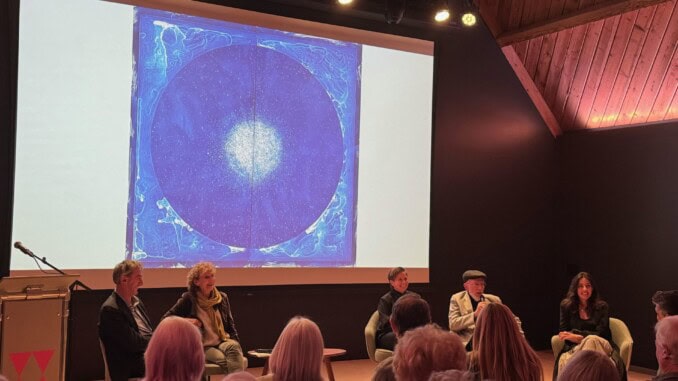
That intersection was talked about on Nov. 21, 2026, at the Wende Museum, where a multigenerational crowd filled a small amphitheater for the panel Visualizing the Cosmos: Science| Art|History. Audience members of all ages greeted the speakers with palm-stinging applause as the program began.
The panel brought together Nobel Prize–winning astrophysicist Kip Thorne, visual artist Lia Halloran, and space historian Lois Rosson. Moderated by History of Science Society President Soraya de Chadarevian and Wende Museum Chief Curator Joes Segal, the discussion examined how art shapes scientific discovery.
Dressed in a brown beret and silver-rimmed aviator glasses, Thorne set an informal tone from the start. Gesturing toward Halloran, who wore her hair slicked back with gel, he opened by joking, “She is my boss, the one who tells me what to say,” underscoring a partnership spanning over a decade.
Halloran’s paintings render the cosmos in swirling layers of blue, red, and black, bringing to life gaseous rings and fluid watercolor textures. She said translating abstract physics into visual form pushed her to a limit, particularly when tackling concepts like vacuum fluctuations.
“[Kip and I] talk for a while until my head gets hot and I need to make some drawings,” Halloran said. Over 13 years, she produced 660 paintings, 120 of which were selected for their 2023 book, The Warped Side of Our Universe: An Odyssey through Black Holes, Wormholes, Time Travel, and Gravitational Waves.
Because astrophysics evolves rapidly, Halloran frequently had to discard completed artwork when new research overturned earlier assumptions. “There would be paintings that would be ‘done,’ and there was a discovery about a black hole, and we had to get rid of that whole section,” she explained.
The practice builds on a long visual lineage stretching back to Chesley Bonestell, widely known as the “father of modern space art.” His landmark 1944 painting, Saturn as Seen from Titan, famously imagined the surface of the moon as alpine-style peaks long before space probes reached outer space.
Today, Thorne noted, visual modeling is embedded directly into scientific methodology. While physicists understand certain properties of dark matter, they rely on simulations of the universe’s evolution.
“They go back and forth between computer simulations and observations and, as far as I’m concerned, paintings,” Thorne said. “It’s a major part of how science is done.”
Rosson traced that collision of science and art back to her early career as a NASA intern, recalling archival works depicting interplanetary space. “One of the most illustrative experiences that I had was in the archive, up at the Ames Research Center, which had in the physical space paintings,” she said.
Thorne has extended scientific visualization into live performance, collaborating with Oscar-winning composer Hans Zimmer on multimedia concerts exploring the origins of the universe.
The panel was offered as a part of the Wende Museum’s current exhibition, Competing Cosmologies: Interpreting the Sky, which examines how Cold War–era communist and capitalist societies interpreted space exploration through art, science, and culture.
Clara Carvalho
