
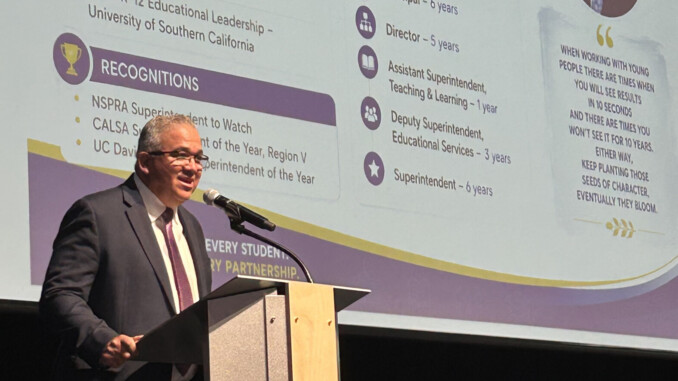
“I’m a science guy, I can always get you the statistics.”
On Thursday, Sept. 17, 2026, Culver City Unified School District Superintendent Dr. Alfonso Jiménez gave the annual “State of the District” address to a small crowd at the Robert Frost Auditorium. The members of the School Board were all on hand, as were a number of teachers, a few district administrators, CCEF leader Wendy Hamill, and WLAC President Dr. Matthew Jordan.
Beginning the evening was a performance by the AVPA Jazz Combo, led by Music Director Dr. Tony Spano; all the musicians were in good form. In the three short years that the CCMS Debate Team has been active (and winning!) it’s become a part of the tradition of the event to have a team member come and offer a speech. The audience was treated to ‘Much Ado About Boredom’ by Christopher Tomasz. A witty and well organized presentation of studies and (well, of course) statistics, punctuated by skillful rhetoric and a few good jokes. Tomasz had a solid presentation, and earned his round of applause.
Statistics were the order of the day, the quantifiable measures be which progress can be noted.
Looking from the administration to the students, Jiménez offered his respect to the National Merit Scholars, the Robotics Team, and many of the sports teams that made California Interscholastic Federation Championships. From the perspective of the outside world looking at the District, there was a great grade from NICHE, a company that rates school districts for real estate companies gave CCUSD an ‘A.’ On the annual report from the California Education Dashboard, CCUSD was one of only two districts out of 80 in Los Angeles County to stay within the top designation of ‘green’ and ‘blue,’ with green being second highest and blue the highest level of performance.
Looking at goals, and the district’s mission statement, he noted “Our students are at the center. With parents, with partners, with supporters – if one group doesn’t work, the wheel can’t turn.”
Drilling down into the exact percentages of gains made by each category of students in Language Arts, Math, and Science, it was the student improvements in Science that were most notable; every group gained.
There was also information about upcoming facilities improvements using Measure E funding; several elementary schools are ready to break ground on new buildings. It was expected that construction will be in process before the end of this year.
Jiménez took a long moment to get very specific about AI and the future of education, noting that the district did not yet have a policy, but that one needed to be created to set rules and guidelines for use. He offered a positive experience that his own daughter had in using a specific tool to help her study for a technical exam. “It’s about using the right tools for the task.”
Out of the many pages of reports and columns of numbers offered in the presentation, attendance and funding were the two categories that leaned on each other the most. “When they are not in school, they are not learning – and, we are not getting paid. Having your students present, every day, is the most important thing, for their time to learn, and our ability to support them.”
Judith Martin-Straw
