
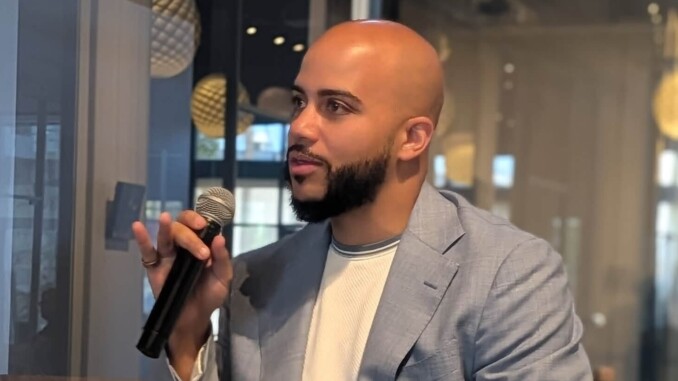
On paper, Culver City appears as an affluent city with median household incomes topping six figures. On the ground, however, local business owners and grassroots leaders are facing financial struggles that state funding metrics ignore. When Assemblymember Isaac Bryan met with local business owners at the Culver City Chamber of Commerce’s Capitol Advocacy Summit on July 28, 2026, a meaningful conversation took place on how rigid state formulas leave local pockets of need stranded.
The event at the Helms Design District, hosted by Chamber of Commerce President Dan O’Brien, addressed the disconnect ithat s a result of how economic need is measured at the state level. Over 90 percent of Culver City’s businesses gross under $400,000 annually, and 60 percent bring in under $200,000. Yet because citywide median household income averages exceed $117,000, state funding programs classify the entire municipality as wealthy.
As a result, small businesses are automatically disqualified from state grants designed for economically disadvantaged areas.
Several major California grant programs rely strictly on these rigid citywide metrics to determine eligibility.
“We can’t use race because of Prop 209. We offer you zip code as proxy, sometimes we use median income. And there are more comprehensive ways that we can look at community.” Bryan said.
Including the Outdoor Equity Grants Program, administered by California State Parks, which funds outdoor trips, sports, and nature programs for urban youth. It requires projects to serve census tracts where the median household income is below 80% of the statewide average.
For Small Business, CalOSBA Micro-Grant Administered by the California Office of the Small Business Advocate, a state relief grants for businesses grossing under $50,000 to $200,000 mandate that recipient businesses must operate within designated Low-to-Moderate Income census tracts.
Addressing the audience, Bryan acknowledged the structural flaws in state funding models. State criteria are often too narrow to capture complex neighborhood needs, especially given constitutional restrictions on using demographic factors.
In response, Bryan pointed to multi-metric evaluation frameworks, such as the state’s environmental mapping tool, CalEnviroScreen, that measures cumulative environmental hazards. Among them is air quality, health outcomes, and neighborhood-level economic distress. Rather than relying on a single median income figure, the state can better distribute funding.
A major pipeline for localized investment stems from Bryan’s legislation, Assembly Bill 2716, which mandates the closure of all oil and gas wells in the Inglewood Oil Field by 2030. It imposes a penalty of $10,000 for operating low-producing wells in violation.
Instead of local non-profits filing competitive applications to compete against high-poverty cities statewide, AB 2716 turns these fines directly into an automatic funding mechanism. The cash goes into a special account dedicated specifically to local repair and park projects.
For local youth sports leagues, that long-term funding offers a pathway to secure support that standard state grants have historically denied. AB 2716’s 2.5-mile perimeter ensures the dollars cannot be routed away to other parts of Los Angeles, locking the funding in for Culver City and the Crenshaw corridor.
Culver City Football Club CFO Rafael Alvarez noted that while the forum did not yield immediate financial fixes, it established a vital channel to Sacramento leadership. “[Bryan’s] response was adequate, because I was not expecting us to come out with a solution today,” Alvarez told Culver City Crossroads, “but find or open a door to a conversation to turn some eyes towards the needs of our city.”
During the pandemic, the Unemployment Trust Fund, which became the lifeline for many including small business, was overly subscribed. Now, those emergency funds are completely exhausted, and standard state accounts offer virtually no dedicated relief grants for small employers. To bridge that deficit, state leaders have pointed to proposals, including California’s proposed wealth tax on billionaires, as a way to generate billions in new funding.
Assemblymember Bryan admitted he remains undecided on whether he will ultimately vote yes or no. “In California, everyone should pay their fair share, folks at the top should pay their fair share for them to take, but if they leave there’s no fair share for them to take. So it’s complicated, and we don’t have all the answers.”
Clara Carvalho
