

This winter season we had quite a lot of rain. Actually, as I’m writing this article I can hear rain drops outside my window. I mean, the La Ballona Creek looks pretty cool with all that water flowing to the ocean. There is always a brave human that walks over and snaps a few videos and pictures and shares with all of us on social media. You may be wondering if you could store some of that rain water for the future. How can I do this, you may ask? Here are some ideas on how to capture rain water for your garden.
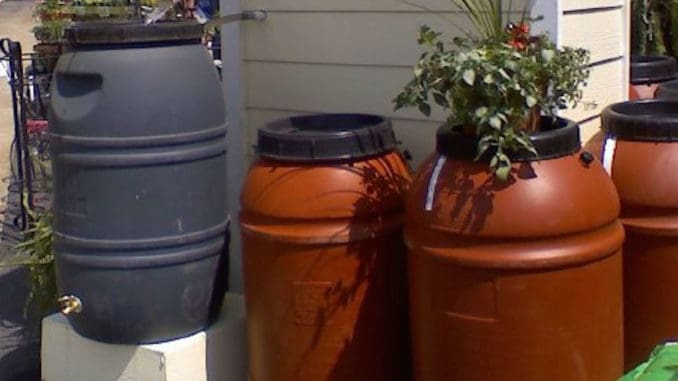
Let’s start with the obvious: rain barrels. What do you need for rain barrels? You need rain gutters. The rain gutter simply ends where the barrel has an opening, and the opening has a net so that debris and mosquitoes cannot go in. You can purchase barrels online, or often get them second hand. People often buy them, but end up not using them and may even give them away for free. There is also a rebate through bewaterwise.com that gives you free rain barrels. Obviously you’ll have to start using the water when your garden’s soil is drying up, and for that I like to use a hose that’s about 20 feet for a good flow. Then I take that hose and let it flow in the garden, especially by trees to deep water them. My husband likes to empty the barrels using a watercan, so that he can water his geraniums that he grows in pots. The barrel also needs to be elevated a bit off of the ground so that the water will properly flow out. There are even big cisterns to capture large amounts of water if you have the room for it. If you do not have rain gutters, but you can see that in certain parts of your roof water will gather and fall in large amounts, setting up rain barrels under that spot will also catch the rain water. However, you want to make sure the rain barrel is stable and will not fall under the weight.
Another very cool way of capturing rain water has to do with your soil. You can move your soil around so the rain water absorbs into the soil instead of just flowing off of the soil and into the street/sidewalk. Berms are great for that— they are little long narrow mounds of soil that you put on the edge of the garden. As water flows from your roof and down hill towards the street, the water stays in the garden. Luckily most houses are set up that way, so it makes this process quite easy. You need the mound to be away from the house to avoid water issues, so the water stays in your garden but not close to your house. Most of the time, I create mounds about 20 feet from the house and near the sidewalk, with the garden sloping towards the sidewalk or street. Another way is using a swell, which is a shallow hole in the ground. Swells will also be away from the house. Additionally, you could also extend your rain gutter underground and let the water go into the swells. You can then plant around the swell or even inside it. There is a great book that explains these types of ways of capturing rain water: “Rainwater Harvesting for Drylands and Beyond” by Brad Lancaster. The book beautifully explains water capturing in simple words, and there are many very self-explanatory pictures to go along with it. Swells and mounds are great for capturing water, especially when you decide to remove your grass and have open space to move soil around your garden. Many people apply for turf removal rebates, where you can find a lot of information about capturing your water. The website for that is bewaterwise.com as I mentioned it above for rain barrels rebate.
Dry river is also another technique of moving the rain water throughout the garden. The river starts at the rain gutter and you can set it up downhill throughout the garden. You use river rocks of different sizes to create the river. As it rains the water will travel downhill watering anything nearby, plus it is a very attractive feature for the garden.
Planting trees at soil level but surrounding the area with a low circular mound of soil at the base will also capture the rain water. However, better yet, if the tree is planted on a small slope and the higher level of the slope has an opening that allows for the rain water to flow around the tree. Also the water would be stopped by the soil mount at the lower base of the tree.
If you have a slope in your garden, you could plant your plants with a mound of soil in front of it. This way when it is raining, some water will stop instead of entirely flowing down the hill. Additionally, native plants with very deep root systems are fantastic choices for slopes so the erosion can be controlled.
In conclusion, capturing your rain water can be done with rain barrels and cisterns or with the smart movement of soil and creation of mounds. So go out there on a rainy day and observe your property to see what you can do in order to capture some of the rain.
Happy Gardening!
Joanna Kotwis
