
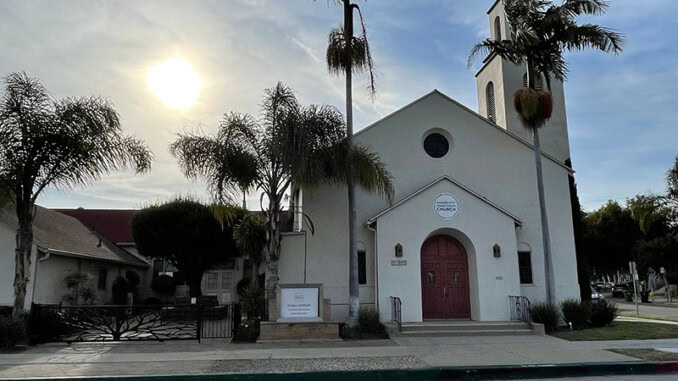

The Culver City Presbyterian Church held a Sunday afternoon ‘teach-in’ on immigration issues on January 25, 2026. Co-hosting the event was LA Voice, a multi-faith organization that connects dozens of local congregations with equity and justice work. Also presenting on the program was West Los, a mutual aid organization. Noted cartoonist Lalo Alcarez, was there as well, auctioning his artwork to raise funds for the support networks.
After a brief introduction by Reverend Frances Rosenau, the church’s pastor, and Culver City’s Mayor Freddy Puza, two USC/Dornsife researchers took the stage with a solid presentation of facts, and detailed data on what the numbers really say. Working under Dr. Manuel Pastor’s Equity Research Institute, Eden Pan and Vanessa Garcia offered that “Data doesn’t always tell a complete story, but it can focus in on a very clear picture.”
In their focus on West Los Angeles, they began with a crop of headlines from local news outlets, noting the issues of the immigration raids were impacting schools, churches, hospitals, and of course, the local economy, in ways that were deeply harmful.
Defining West Los Angeles as the areas of Santa Monica, Central Westwood, West Los Angeles, Century City, Palms, Marina del Rey Westchester and Culver City, “A third of Los Angeles County’s residents are immigrants (3.5 million) and just over a quarter of the immigrant population are undocumented (948,700.) 47% of undocumented immigrants in West LA are Latino, with 24% being White, and 21% being Asian… Though Latinos still make up the majority of undocumented Westsiders, West LA has a higher proportion of white and Asian American undocumented population compared to the state and county.
This means that about 4% of residents in West LA are estimated to be undocumented, a lower percentage than the county and state. “The data, however, does not capture the entire community, especially those who work in West LA but reside in other parts of the county.” Consider the daily traffic on the 405 or the 10, and those numbers could increase exponentially.
The terror inflicted by the raids begins to come into a sharp focus with a few more statistics, “Among children in Los Angeles County ages 5 and under with parents living in their household, a fifth (123,000) have at least one undocumented parent. Youth living with undocumented family members will be heavily impacted by ICE raids as we see more than half (55%) of US citizens with undocumented family members are 17 years old and younger.” The traumatic impact of losing a parent at an early age has been studied in many contexts.
As evidenced by the abduction of Enrique Lozano, the “ice cream man,” which provoked huge local response, many undocumented immigrants have lived here for years, and have deep roots in our community. “Nearly three-quarters of the undocumented population in Los Angeles County have been in the country for more than a decade.”
The impact to the local economy has been huge. “In 2023, undocumented immigrants paid more than $2 Billion dollars in state and local taxes, and had an estimated spending power of just over $20 Billion dollars. Since January of 2025, state wide private-sector employment is down 742,000 jobs, just under three-quarters of a million jobs lost because of raids and abductions.” Citizens are equally vulnerable in many industries, particularly construction, transportation and food service.
Moving into the question of ‘what can the local community do?’ The organization West Los noted the need for legal aid, Know Your Rights workshops, bail funds, and rapid response. “It’s very kind for people to want to donate food, but groceries can be bulky to store and distribute; what’s most needed is your financial support, and your time.”
Mayor Puza closed the event by noting that Culver City’s sanctuary city status, dating back to 2017, would be on the agenda at the January 25, 2026 council meeting in regards to a resolution on preventing federal immigration from using or accessing any of Culver City’s property, and he encouraged those interested to attend the meeting.
Judith Martin-Straw
